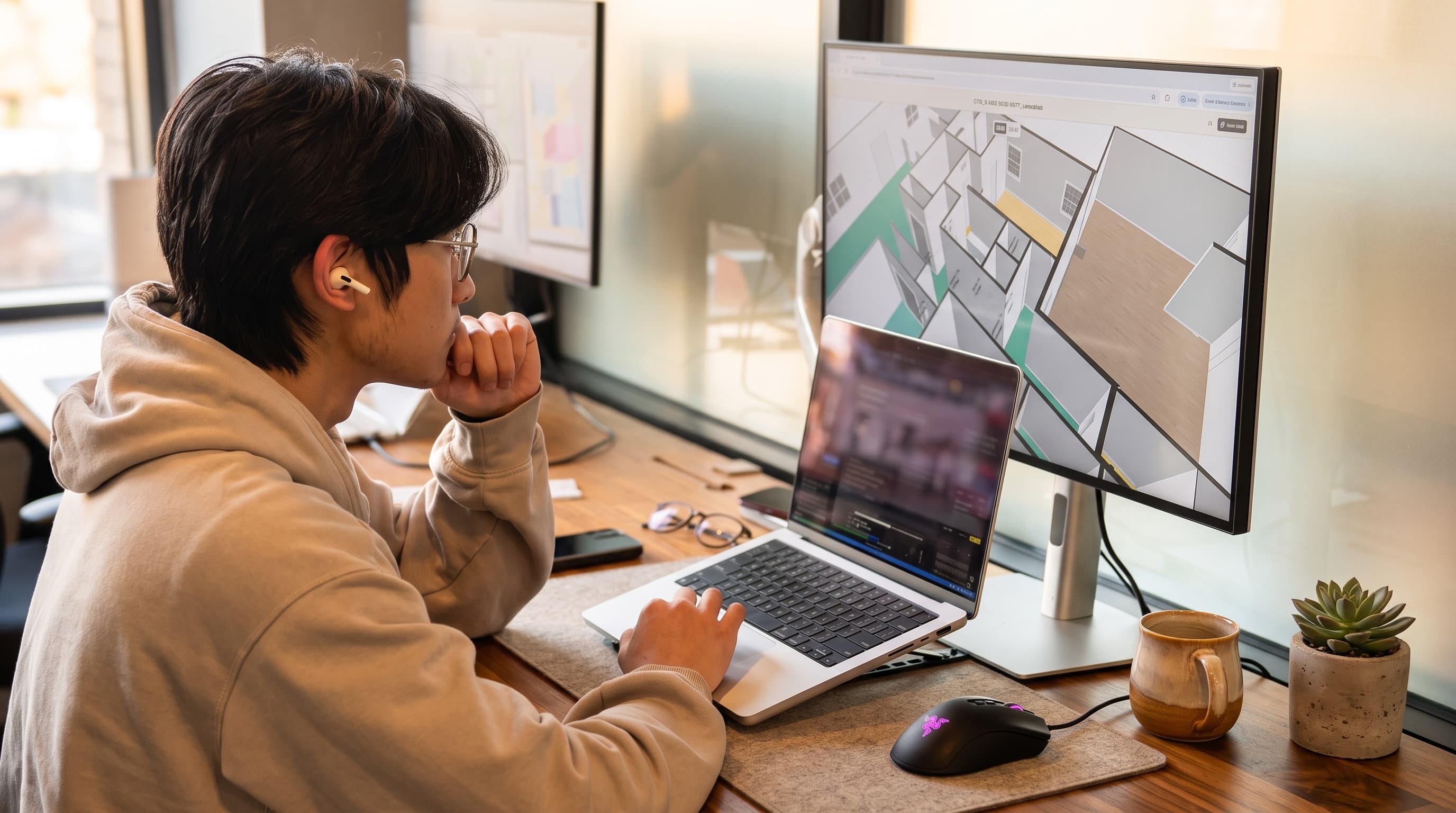
Structural cognition for the built world.
The problem
Today’s models don’t reason natively about the built environment
Language and image models approach the physical world indirectly, through text, pixels, or rendered views. They can describe spaces, generate images of them, and increasingly produce 3D scenes. But are text and pixels sufficient to be a foundation for how we design the built world?
The multi-trillion dollar Architecture, Engineering, and Construction (AEC) industry is governed by dimensional precision, regulatory constraints, construction sequencing, material behavior, and deep spatial reasoning. However, frontier generative models are only trained to produce what a space looks like, not how it can be built.
We set out to build the first foundation models that natively reason about the built world.
Our approach
We model space as structure, not as pixels.
Dream represents the built world as structured, relational, physically grounded data, and trains generative models to reason directly over it: over constraints, relationships, and design intent. The result is a system of models that understand how that world is assembled, how it functions, and how it can be transformed.
Dream is building the foundation model stack for the built world.
Dream architectural and engineering intelligence generates 3D layouts that are not just realistic, but structurally coherent and aligned with real-world design patterns. It understands and reasons about 3D spaces and rationalizes the different interactions of objects within those spaces. The output is a layout you can actually build, not just a pretty picture.
Dream style intelligence adds in design via multimodal retrieval, compatibility-scoring, and real-product matching system built on a Style Ontology of unique designs and architectural styles. It chooses real materials, fixtures, furniture, and decor that are coherent and aligned with real-world design patterns.
Structural cognition reasons about built space natively.
If the built world intrigues you too, get in touch with us at inspired@dreamhq.com
Meet the minds behind the models
Dream is a focused research-and-product lab in San Francisco, uniting frontier machine-learning research with deep real-world product experience: engineers, researchers, product leaders, and architects working to decode and model the built world.